February 26, 2026
Supreme Court Bans NCERT Class 8 Textbook Over 'Corruption' Chapter; Issues Contempt Notice to Director
Advocate Ravi Rai Sharma (Legal Ravi) analyzes the Supreme Court's 2026 blanket ban on the NCERT Class 8 Social Science textbook. Understand the "Judiciary is Bleeding" verdict, the legal grounds for contempt, and the impact on India's education system.
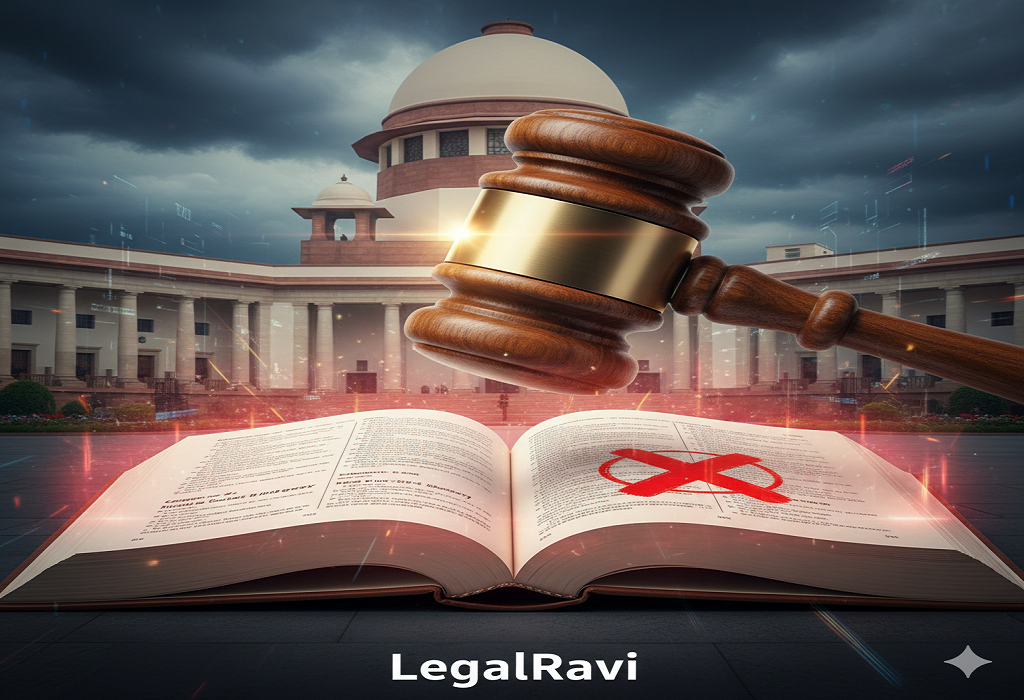
In a massive judicial crackdown on the educational curriculum, the Supreme Court of India on Thursday (February 26) imposed a nationwide blanket ban on the publication and distribution of the NCERT Class 8 Social Science textbook. The Court took suo motu cognizance of a chapter titled "The Role of the Judiciary in Our Society," which contained scathing references to "corruption in the judiciary."
The Bench, comprising Chief Justice of India Surya Kant, Justice Joymalya Bagchi, and Justice Vipul M. Pancholi, described the move as a "deep-rooted conspiracy" to malign the integrity of the judicial institution in the eyes of impressionable young students.
The Order: Immediate Seizure and Digital Takedown
The Court’s directions were absolute and left no room for ambiguity. The Bench has directed:
- Physical Seizure: NCERT, in coordination with Union and State Education Departments, must ensure every hard copy in retail stores or schools is seized and sealed.
- Digital Scrubbing: The Centre is directed to ensure all soft copies (PDFs) are removed from public access and social media.
- Instruction Ban: No teacher across India is permitted to impart any lesson based on the "offending" content of the subject book.
- Personal Accountability: The NCERT Director and Secretary of School Education must show cause why they should not be prosecuted under the Contempt of Courts Act, 1971.
The Spark: "Corruption in the Judiciary" in Class 8
The controversy erupted within 48 hours of the book’s release (February 24, 2026). The book, part of the new National Curriculum Framework (NCF), contained a sub-topic in Chapter 4: "The Role of the Judiciary in Our Society" that explicitly detailed "corruption in the judiciary."
What exactly was written?
According to the Court's observations, the text:
· Focused heavily on a "one-sided narrative" of judicial corruption and case backlogs (4.7 crore pending cases).
· Cited "hundreds of complaints" against judges in a way that suggested systemic inaction.
· Omitted the transformative work of the Courts, such as Free Legal Aid, protection of Fundamental Rights, and the Basic Structure Doctrine.
"Judiciary is Bleeding": Top Quotes from CJI Surya Kant
The hearing witnessed sharp remarks from the Bench. When Solicitor General Tushar Mehta informed the Court that the NCERT had already expressed "regret" and withdrawn the book, the CJI was not convinced.
"The press release issued by NCERT does not have a single word of apology. They fired the gunshot; the judiciary is bleeding today. We cannot teach our children that justice is denied in this country," CJI Surya Kant remarked.
The courtroom exchange on February 26 was intense. CJI Surya Kant, alongside Justices Joymalya Bagchi and Vipul M. Pancholi, didn't mince words:
· "Heads Must Roll": The CJI made it clear that a mere apology wasn't enough. He demanded to know the names of the National Syllabi Board members responsible.
· "Deep-Rooted Conspiracy": The Bench remarked that the inclusion of such material wasn't an "oversight" but a "calculated move" to malign the institution.
· "The Gunshot": In a poignant metaphor, the CJI stated: "They have fired the gunshot and the judiciary is bleeding today. The morale of judges is down."
Legal Deep Dive: Section 2(c) and the Power of Contempt
As a legal professional, it is vital to understand why this isn't just a "mistake" but a "misconduct."
1. Scandalizing the Court: Under Section 2(c) of the Contempt of Courts Act, any publication that "scandalizes" or lowers the authority of a court constitutes Criminal Contempt. The Court held that targeting Class 8 students with a one-sided narrative is a "calculated move" to erode public esteem.
2. Breach of Article 129: The Supreme Court, as a Court of Record, has the inherent power to protect its dignity. The Bench noted that while "legitimate criticism" is allowed, "indoctrination" is not.
Detailed Timeline of the 2026 NCERT Crisis
What Happens to the 2.25 Lakh Books?
The logistical impact is massive. Out of the 2.25 lakh copies printed, only 38 copies had been sold before the ban. The Court has ordered:
1. State Compliance: Principal Secretaries of Education in all states must ensure no instruction is imparted using this book.
2. Digital Scrubbing: The Centre must issue "Take Down" orders to ISPs to remove the PDF from the internet.
3. Compliance Report: A report must be filed within two weeks detailing the seizure of all distributed copies.
Impact on the 2026-27 Academic Session
The logistical fallout of this order is immense. With over 2.25 lakh copies printed, the Ministry of Education is now in a race against time. NCERT has committed to rewriting the chapter, but the Court has demanded the names and credentials of the specific individuals involved in the original drafting to fix accountability.
With the academic session starting soon, schools are in a bind.
· Revision Timeline: NCERT has promised to rewrite the chapter by March 2026.
· Digital Alternatives: Schools are advised to wait for the official "Revised Edition" before adding the Social Science book to their curriculum.
The Constitutional Debate: Freedom of Speech vs. Institutional Sanctity
While Article 19(1)(a) protects the right to freedom of speech, it is subject to "reasonable restrictions" in the interest of the "decency or morality" or in relation to "contempt of court."
The Supreme Court clarified: "We do not propose to stifle legitimate criticism... but the integrity of education must be upheld."
The "LegalRavi" Perspective: A Balance of Freedom and Respect
While the Right to Freedom of Speech (Article 19) is a pillar of our democracy, it is not an absolute license to defame constitutional institutions. The education system must reflect a balanced view. As the Court rightly noted, the book reached not just children, but parents and wider society.