September 20, 2026
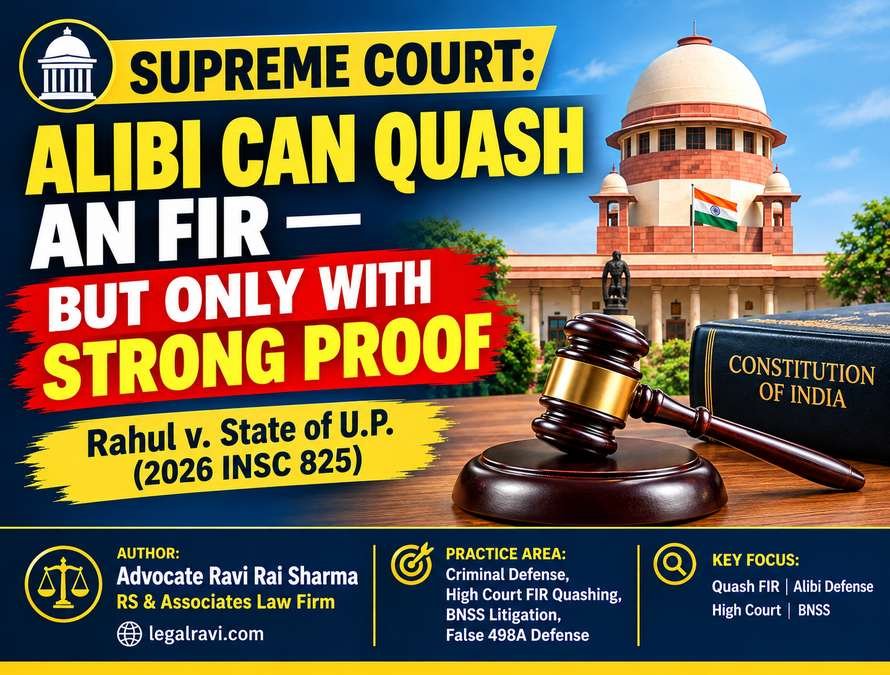
PLEA OF ALIBI CAN QUASH FIR AT THRESHOLD: SUPREME COURT IN RAHUL V. STATE OF UP (2026 INSC 825)
- Author: Advocate Ravi Rai Sharma - RS & Associates Law Firm
- Practice Area: Criminal Defense, High Court FIR Quashing, BNSS Litigation, False 498A Defense
- Primary Target Keywords: plea of alibi quash fir supreme court, rahul vs state of up 2026 insc 825, section 528 bnss quashing fir, quash false 498a fir high court jaipur, can fir be quashed on alibi
1. THE LANDMARK RULING: BREAKING THE CONVENTIONAL ALIBI NOTION
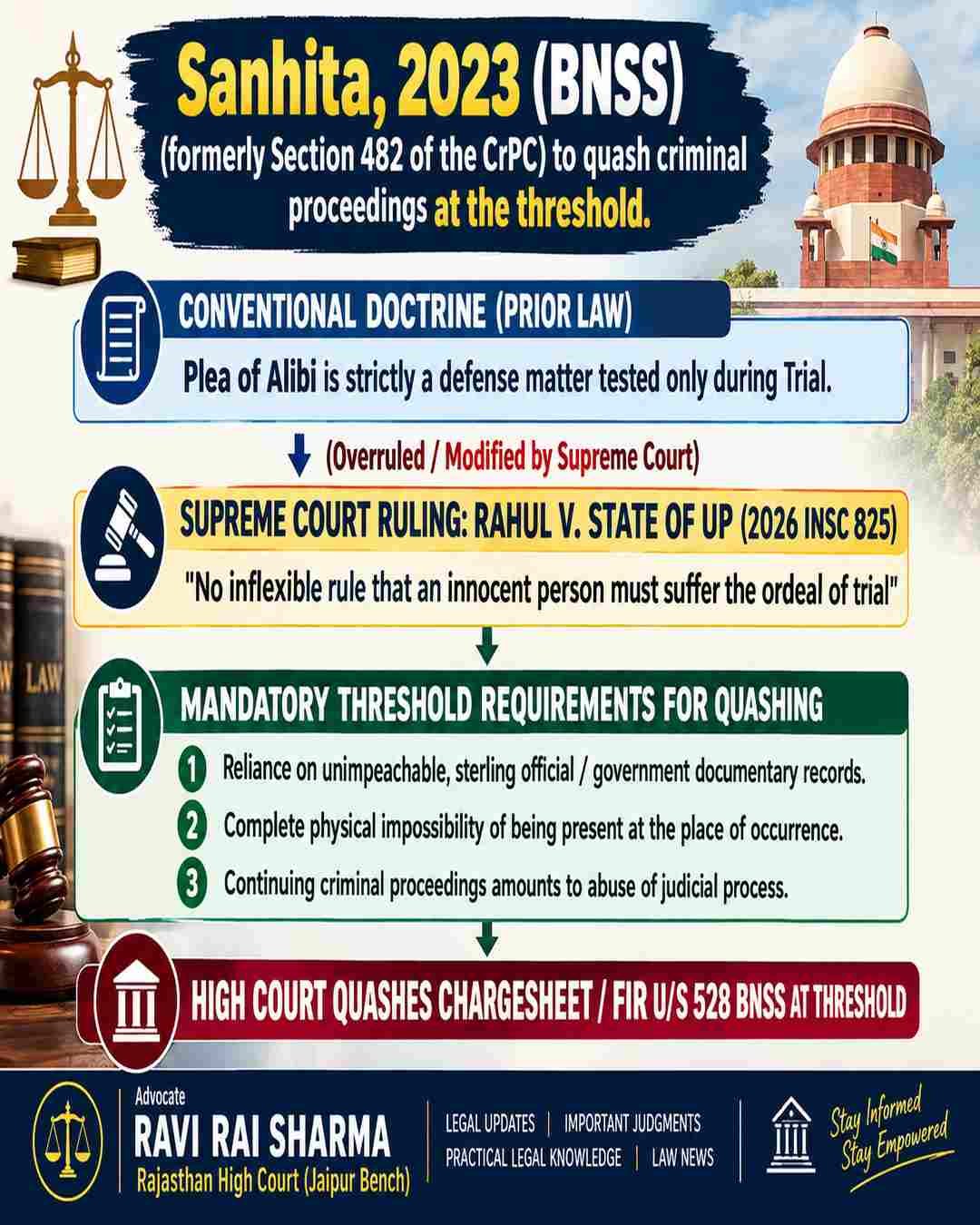
For decades, a rigid principle dominated Indian criminal jurisprudence: the Plea of Alibi (establishing that the accused was elsewhere when the alleged offense occurred) was treated strictly as a defense to be examined during trial evidence. Under this traditional view, even an accused with indisputable official proof of absence had to endure years of framing of charges, witness examinations, and lengthy courtroom trials before claiming relief.
In the landmark judgment Rahul v. State of Uttar Pradesh & Anr. (2026 INSC 825), the Supreme Court of India dismantled this rigid doctrine.
The Division Bench comprising Justice Sanjay Karol and Justice Augustine George Masih held that there is no inflexible rule that a plea of alibi must only be considered at the conclusion of a full-fledged trial. The Court affirmed that where the accused places reliance on unimpeachable, undisputed official or public records conclusively excluding their physical presence from the scene of occurrence, High Courts possess inherent jurisdiction under Section 528 of the Bharatiya Nagarik Suraksha Sanhita, 2023 (BNSS) (formerly Section 482 of the CrPC) to quash criminal proceedings at the threshold.
2. CASE FACTS: THE BSF PERSONNEL DISPUTE
- The Complaint: In 2016, an FIR was lodged alleging cruelty, dowry harassment, and dowry death (Sections 498A, 304B IPC) against a serving Border Security Force (BSF) personnel and his relatives.
- The High Court's Refusal: The Allahabad High Court declined to quash the chargesheet, reasoning that the appellant's service certificate—verifying active operational duty at a border outpost hundreds of kilometers away—constituted a "Plea of Alibi" that could only be tested as defense evidence during trial.
- Supreme Court's Verdict: Setting aside the High Court’s ruling, the Supreme Court quashed the criminal proceedings[cite: 1]. The Apex Court held that when official government records demonstrate that an accused could not have been present at the place of the crime, forcing that individual to face a decade of criminal trial elevates rigid procedural formalism above substantial justice[cite: 1].
3. PRACTICAL APPLICATION UNDER SECTION 528 BNSS (SECTION 482 CrPC)
This ruling serves as an effective defense against omnibus allegations frequently seen in matrimonial disputes, dowry complaints, workplace conflicts, and property litigations:
- Relief for Distant and Outstation Relatives: Relatives residing in other cities or working on documented shifts who are routinely named in matrimonial complaints can now seek immediate quashing before the High Court.
- Admissibility of Unimpeachable Official Records: The High Court can scrutinize verified public employment records, armed forces rosters, biometric government attendance, and verified immigration stamps at the petition stage without conducting a mini-trial.
- Preventing Judicial Harassment: Stopping baseless criminal complaints before the framing of charges prevents procedural delays and reputational damage.
4. FREQUENTLY ASKED QUESTIONS (FAQS)
Q1: Can an FIR or chargesheet be quashed on a plea of alibi before trial starts?
Effect: Yes[cite: 1]. In Rahul v. State of UP (2026 INSC 825), the Supreme Court held that where undisputed official documentary proof confirms the accused was not present at the crime scene, High Courts have inherent powers under Section 528 BNSS / Section 482 CrPC to quash proceedings at the initial stage[cite: 1].
Q2: What evidence meets the standard of "unimpeachable document" for alibi quashing?
Effect: Official government duty registers, armed forces deployment certificates, verified hospital admission sheets, verified institutional biometric data, and passport/immigration entry-exit records. Casual private affidavits or unverified private statements do not qualify.
Q3: Which provision of the new criminal laws governs FIR quashing in 2026?
Effect: Section 528 of the Bharatiya Nagarik Suraksha Sanhita, 2023 (BNSS) preserves the inherent powers of the High Court to prevent abuse of the process of any court and secure the ends of justice, replacing Section 482 of the CrPC.
5. HIGH COURT FIR QUASHING & CRIMINAL DEFENSE IN JAIPUR
Defending against false criminal complaints requires timely verification of digital and official evidence and prompt petition filing before the High Court:
- Litigation Practice: High Court Quashing Petitions (u/s 528 BNSS), Anticipatory Bail, and Trial Defense.
- Court Jurisdiction: Rajasthan High Court (Jaipur Bench) and Sessions Courts.
- Chamber Office: RS & Associates Law Firm, 117-A, 1st Floor, Sun N Moon Building, VKIA-1, Near Manipal Hospital, Sikar Road, Jaipur, Rajasthan 302039.
- Website & Inquiries: Advocate Ravi Rai Sharma - RS & Associates Law Firm