January 19, 2026
Best Cheque Bounce Lawyer in Jaipur | Expert Section 138 NI Act Recovery Specialist
Author: Advocate Ravi Rai Sharma | Category: Criminal Law / Debt Recovery | Jurisdiction: Jaipur, Rajasthan
In the highly competitive business landscape of Jaipur, a cheque bounce case (cheque dishonour) is a serious legal hurdle that can instantly disrupt your cash flow. Whether you are a business owner, a corporate entity, or an individual trader, recovering your hard-earned money requires a swift, technical, and strategic approach under Section 138 of the Negotiable Instruments Act, 1881.
Many people remain confused about whether to file a civil recovery suit or initiate criminal proceedings when a cheque is returned unpaid. Section 138 provides a powerful criminal remedy that not only fast-tracks financial recovery but also carries the strict deterrent of imprisonment for the defaulter.
(Note: If your financial dispute relates to banking loan defaults, NPA accounts, or illegal harassment by recovery agents rather than a business transaction, you can read our specialized guide: Bankruptcy Lawyer in Jaipur: Legal Remedies to Deal with Loan Default & Bank Recovery).
🔍 Deep Dive into Cheque Bounce: When Does it Become a Crime?
Not every unpaid cheque constitutes a criminal offense. To legally file a 138 Cheque Bounce Case, the following statutory conditions must be met:
· Legally Enforceable Debt: The cheque must have been issued by the drawer strictly to discharge an existing, legally valid debt or liability. If a cheque was given as a pure gift, a donation, or for an unlawful transaction, it cannot be prosecuted under Section 138.
· Reason for Dishonour: The cheque must be refused by the bank due to specific reasons, most commonly 'Insufficient Funds', 'Account Closed', or 'Signature Mismatch'.
· Bank Cheque Bounce Charges: Upon dishonour, banks levy internal financial penalties (such as standard Kotak cheque bounce charges or generic cheque return charges) on both the drawer and payee. These official return memos serve as primary evidence in a court of law.
· ECS Bounce Charges: It is important to note that electronic auto-debit failures trigger ECS bounce charges, which carry the exact same legal weight as a physical check bounce under Section 25 of the Payment and Settlement Systems Act.
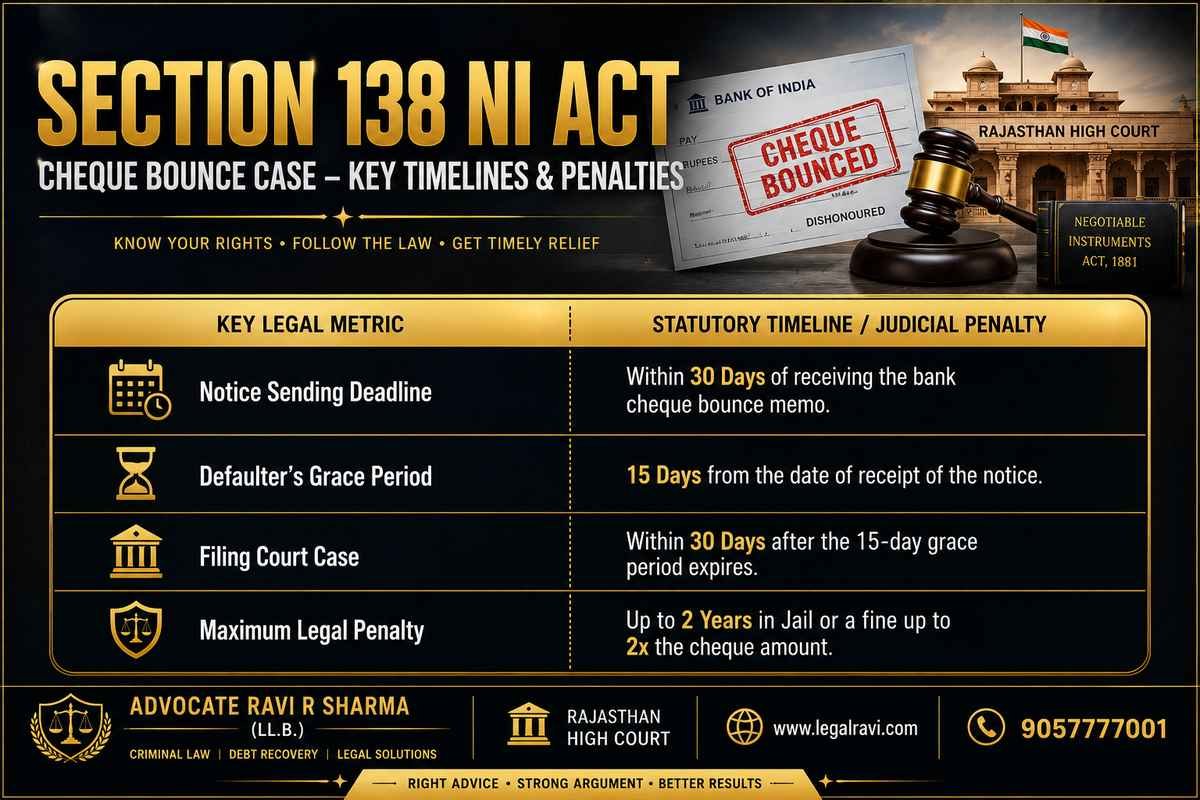
⏱️ The Strict Timeline: Miss a Deadline, Lose Your Case
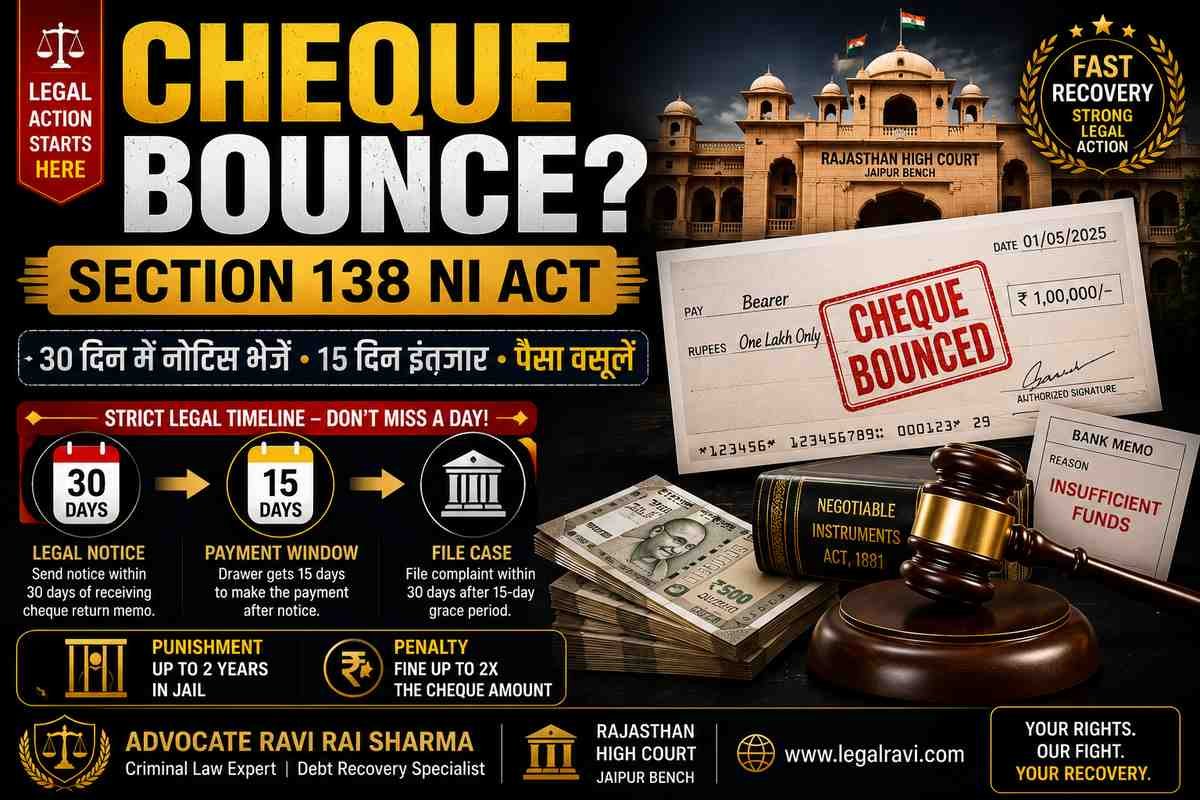
The law surrounding cheque dishonour cases is strictly time-bound. A single day's delay can result in the permanent dismissal of your right to file a criminal complaint. Courts in Jaipur (Bani Park) strictly enforce this statutory timeline:
1. Cheque Return Memo (Day 0): The moment your bank returns the cheque unpaid along with an official 'Cheque Return Memo', your legal countdown begins.
2. Demand Notice (Within 30 Days): You must draft and serve a formal, airtight legal notice to the drawer within 30 days of receiving the bank memo. It is highly recommended to route this through a best criminal advocate in jaipur to avoid technical flaws.
3. The 15-Day Grace Period: Once the notice is delivered, the law grants the drawer a 15-day grace period to clear the dues. You cannot initiate court proceedings before these 15 days expire.
4. Filing the Complaint (Within the Next 30 Days): If the drawer fails to pay within the 15-day window, you must file a formal criminal complaint before the competent Judicial Magistrate (JMFC Court, Jaipur) within the next 30 days.
(Note: If you are dealing with malicious police harassment or malicious prosecution instead of financial fraud, please consult our procedural manual: How to Quash a False FIR? Section 528 BNSS (Old 482 CrPC) Full Guide).
⚖️ Penalties and Punishment for a 138 Cheque Bounce
The penalty on a check bounce is designed to protect commercial trust in commercial transactions:
· Imprisonment: Upon conviction, the offender faces a check bounce case punishment of up to 2 years in jail.
· Heavy Financial Penalty: The court can impose a bounce cheque penalty or cheque bounce penalty charges amounting to up to double the cheque value, which is awarded to the complainant as compensation.
· 20% Interim Compensation: Under recent amendments, the magistrate court can order the accused to pay 20% of the cheque value as interim relief to the complainant while the trial is still ongoing.
🏛️ Official Legal Notice Format for Cheque Bounce (Section 138 NI Act)
This notice must be dispatched via Registered Post AD or Speed Post within 30 days of the cheque return. Retaining the original postal receipts and tracking report is vital for evidence management.
LEGAL NOTICE
To,
[Name of the person who signed the cheque]
[Full Address]
Date: [Insert Date of Sending]
Subject: Legal Notice under Section 138 of the Negotiable Instruments Act, 1881 regarding dishonour of Cheque No. [Insert Cheque Number].
Dear Sir/Madam,
Under instructions from and on behalf of my client, [Your Name/Company Name], resident of Jaipur, I hereby serve you with the following legal notice:
1. That you issued a cheque bearing No. [Cheque Number] dated [Cheque Date] for an amount of Rs. [Amount in Figures]/- (Rupees [Amount in Words] only) drawn on [Name of Bank and Branch] in favor of my client towards the discharge of your legally enforceable debt/liability.
2. That my client presented the said cheque for encashment through their banker, [Your Bank Name, Jaipur Branch], but the same was returned unpaid by your bank with the remark "[Insert Reason, e.g., Insufficient Funds]" via a Cheque Return Memo dated [Date of Memo].
3. That the cheque return has caused my client significant financial loss and mental agony, and you are also liable for bank cheque bounce charges incurred.
4. Through this notice, I hereby call upon you to make the payment of the said amount of Rs. [Amount]/- to my client within 15 days from the date of receipt of this notice.
5. Please note that if you fail to make the payment within the stipulated 15 days, my client shall be constrained to initiate a 138 cheque bounce case against you in the competent court of law at Jaipur. You shall be liable for the check bounce case punishment, including imprisonment up to 2 years and a bounce cheque penalty of up to double the cheque amount.
Yours faithfully,
Advocate Ravi Rai Sharma
Jaipur
🛡️ Strategic Defense: Cheque Bounce Case in Favour of Accused
As a top criminal lawyer in jaipur, our chamber also specializes in securing a cheque bounce case in favour of the accused. Common legal defenses to secure an acquittal include:
· Security Cheque Defense: Proving that the cheque was handed over purely as a security/collateral deposit during an old agreement, and no active legally enforceable debt existed when it was encashed.
· Time-Barred Debt: If the underlying financial transaction or debt is older than 3 years, it becomes legally irrecoverable, rendering the 138 complaint void.
· Technical Flaws in Notice: If the demand notice fails to specify the exact cheque details or was sent after the 30-day statutory window, the entire case faces dismissal.
(Note: For complex matters involving matrimonial disputes, alimony, or domestic properties linked to these disputes, refer to our comprehensive legal resource: Best Divorce Lawyer in Jaipur: Navigating Family Court & Matrimonial Litigation.
Frequently Asked Questions
Q1. What if the cheque bounces but the drawer has already closed the bank account?
Ans: If the drawer closes the account after issuing the cheque or just before it is presented to avoid payment, it is legally treated as an attempt to cheat. The Hon'ble Supreme Court has ruled that account closure does not exempt the drawer from criminal liability; it rather strengthens the payee's case under Section 138 of the NI Act.
Q2. Can a 138 NI Act case be filed if the cheque bounce memo says "Signature Mismatch" or "Image Not Found"?
Ans: Yes. A common loophole drawers try to use is intentionally changing their signature. The courts explicitly hold that if a cheque returns due to a signature variance, it still falls under the ambit of Section 138, provided the other statutory notice timelines are strictly followed. A forensic expert can be called by your lawyer to prove forgery.
Q3. The drawer paid me a partial amount after receiving the 138 notice. Can I still file the criminal case?
Ans: No, you cannot file a case for the entire cheque amount if a partial payment was accepted during the 15-day grace period. You can only prosecute for the remaining legally enforceable balance. If they make a partial payment, it is legally safer to demand a fresh cheque or note the acknowledgment before approaching the Jaipur Court.
Q4. Can I file a cheque bounce case against a company director if the cheque was issued from the company's account?
Ans: Yes, but under Section 141 of the NI Act (Vicarious Liability), you must array both the Company as an accused and the specific Director who signed the cheque or was in charge of the daily business operations. Filing a case only against the director without naming the company will lead to immediate dismissal.
Q5. Can a power of attorney (PoA) holder file a cheque bounce complaint on behalf of the actual payee?
Ans: Yes. A Power of Attorney holder can validly file a Section 138 complaint and depose in court, provided they have personal knowledge of the underlying transaction and the debt. The complaint must still be registered in the name of the actual payee.
Q6. What happens if the drawer completely refuses to accept the Speed Post/Registered Post Legal Notice?
Ans: If the notice is returned with postal remarks like "Refused to Accept," "Not Claimed," or "House Locked," the law deems it as "Deemed Service" (Constructive Notice). Under Section 27 of the General Clauses Act, the 15-day countdown begins from the date of such refusal, and you can proceed to file the case.
Q7. Can I file a Section 138 case and a Police FIR for cheating (Section 318 BNS / Old 420 CrPC) simultaneously?
Ans: Yes. A cheque bounce case is a distinct statutory offense under the NI Act, whereas a criminal case for cheating under the new Bhartiya Nyaya Sanhita (BNS) requires proving a dishonest intention right from the inception of the transaction. Both remedies can run parallelly without overriding each other.
📞 Fast Track Recovery & Expert Consultation
When dealing with a case on cheque bounce, every single day counts. Serving an legally sound notice immediately after a cheque return often forces the defaulter to settle the matter out of court, saving you from prolonged litigation.
· 📍 Main Chamber: 117-A, Sun N Moon Building, VKIA-1, Sikar Road, Jaipur, Rajasthan - 302039
· 📞 Helpline: +91 9057777001
· 🌐 Official Website: www.legalravi.com
· 💼 Courts of Practice: Rajasthan High Court (Jaipur Bench) & Supreme Court of India (New Delhi).
📊 Summary Table: Quick Guide for Jaipur Clients