August 01, 2026
Supreme Court Landmark Judgment: Can Adultery Bar Interim Maintenance u/s 125 CrPC?
Author: Advocate Ravi Rai Sharma | Category: Family Law & Supreme Court Verdicts | Jurisdiction: Family Courts & Supreme Court of India
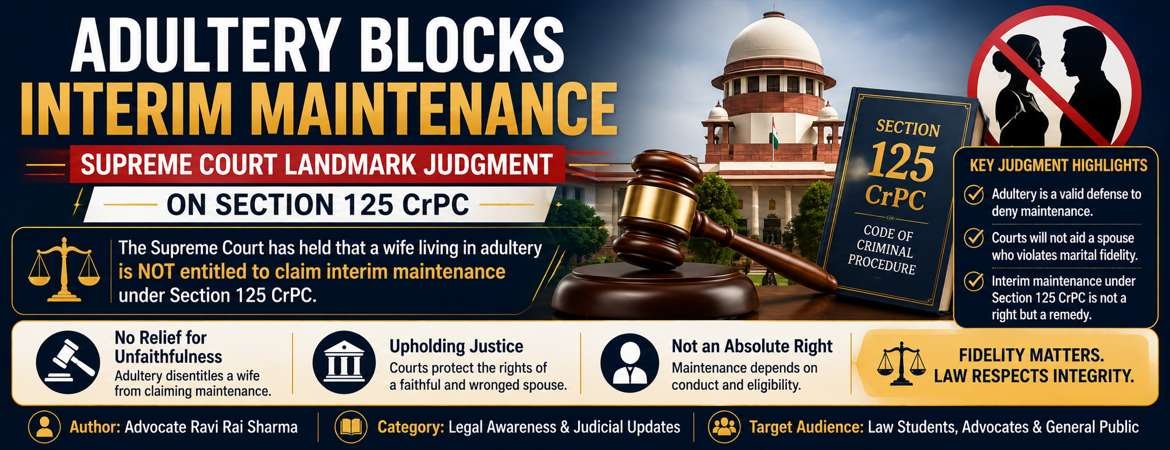
Can a wife claim immediate financial support from her husband even if there is clear, undeniable proof that she is living in an extra-marital affair? In a pathbreaking landmark judgment delivered on July 31, 2026, the Supreme Court of India established a crucial legal boundary: NO.
Ordinarily, family courts order the husband to pay "Interim Maintenance" to the wife right at the beginning of a dispute so she can survive during the long trial. However, what happens if the husband has concrete, solid evidence at the very first stage showing that the wife is unfaithful? Should he still be forced to pay her until the final judgment?
Most men facing divorce and young advocates search online for interim maintenance rules in india or want to understand the adultery grounds under section 125 4 crpc. In the sensational case of Himanshu Chordia v. State of Rajasthan & Anr. (2026), the apex court ruled that lower courts cannot take a blind view of the law and ignore early evidence of infidelity.
In this simple, layman guide, Advocate Ravi Rai Sharma decodes this latest Supreme Court order, the power of Section 125(4) CrPC, and its equivalent provision under the new Bhartiya Nagarik Suraksha Sanhita (BNSS).
(Note: If your legal emergency involves criminal property fraud, fake police cases, or quashing an FIR in the state instead of domestic family court arguments, review our dedicated defense manual: How to Quash False FIR in Rajasthan High Court: Section 528 BNSS Strategy Guide).
⚖️ The Shield of Section 125(4) CrPC (Now Section 144(4) BNSS)
The Indian legal framework under Section 125 of the CrPC is designed to prevent destitute wives from starving. However, the legislature wisely placed a vital check under Section 125(4) CrPC (now beautifully carried forward under Section 144(4) of the BNSS). This sub-section clearly states that a wife shall not be entitled to receive any maintenance or allowance from her husband if:
- She is living in adultery (extra-marital affair).
- She refuses to live with her husband without any sufficient reason.
- They are living separately by mutual consent.
The Legal Error Corrected by the Supreme Court
In the Himanshu Chordia case, the couple married in 2014, and after relations soured, the wife left the matrimonial home in 2020. When she filed for monthly support, the husband immediately moved an application under Section 125(4), placing solid photographic evidence and electronic records proving her infidelity.
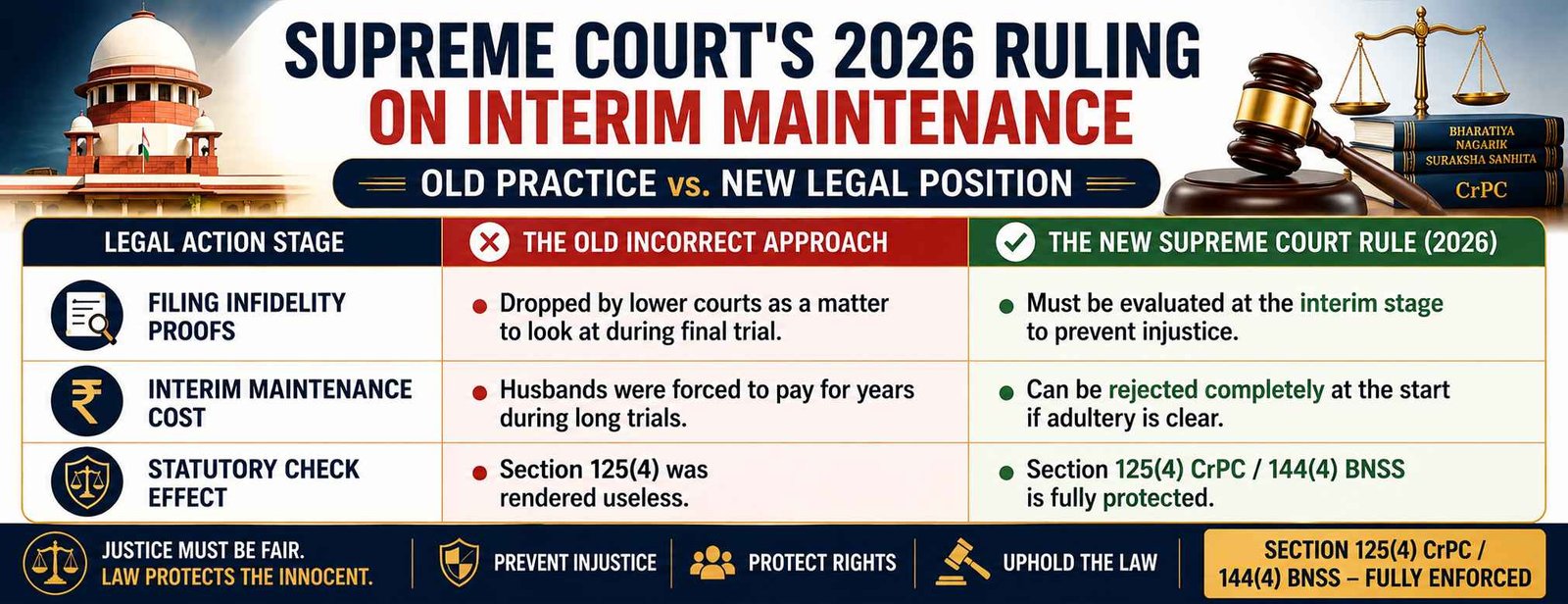
However, the Family Court and the Rajasthan High Court rejected the husband's plea at the threshold, stating that the authenticity of such adultery proofs can only be tested at the final stage of trial after full cross-examination.
Setting aside this wrong approach, a division bench of Justice Sanjay Karol and Justice Vipul M. Pancholi ruled that if a husband files a plea under Section 125(4) and produces clear prima facie evidence proving the charge of adultery at the absolute initial stage, the court must evaluate it right then and can refuse interim maintenance. The apex court noted that delaying this review until the final trial stage completely defeats the practical purpose of the statutory check.
🌐 Official Portals for Verifying Family Court Data (Live Status Links)
Our legal chamber ensures precise statutory tracking under the running criminal and family law codes. To check institutional order lists or verify daily case logs independently, you can directly access the government gateways below:
- Supreme Court of India Official Site: The ultimate portal to read certified judgment copies, trace operational case files, and review daily constitutional rosters.
- eCourts Services India Network: Access instant case status, track running family court records in Jaipur, and view daily dynamic listings.
- Rajasthan High Court Portal: Track appellate submissions, download administrative rules, and verify standing benches online.
❓ Frequently Asked Questions (Top Matrimonial Disputes Solved Simply)
Q1. What kind of proof is required to show adultery at the interim stage?
Ans: The court will not accept casual doubts or vague allegations. To stop interim maintenance, the husband must present solid, untamperable prima facie evidence. This can include explicit WhatsApp chat backups, authenticated travel logs showing the wife stayed in a hotel room with another man, or clear photographic proofs accompanied by a validation certificate under Section 63 of the Bhartiya Sakshya Adhiniyam (BSA).
Q2. What is the equivalent section for Section 125 CrPC under the new criminal laws?
Ans: Under the new Indian criminal codes applicable in 2026, the old Section 125 of the CrPC is now Section 144 of the BNSS. The specific check for adultery is placed under Section 144(4) BNSS. The core principles remain identical, but courts are enforcing stricter timelines for filing replies.
Q3. Does a single act of infidelity completely bar a wife from getting maintenance?
Ans: The standard legal phrase used in the section is "living in adultery," which historically implied a continuous and systematic adulterous relationship rather than a single isolated lapse. However, with this latest 2026 Supreme Court order, if the husband can conclusively establish an active extra-marital affair at the start, family courts have the full power to pause the cash outflow instantly.
Q4. Can a young lawyer use this judgment during corporate or litigation internships?
Ans: Yes, this is a phenomenal reference tool! If you are performing a law firm internship or working with a family court advocate, you can create winning written arguments for distressed husbands by citing this case. It demonstrates to your senior that you track real-time judicial shifts instead of just reading old textbooks.
📊 Tactical Matrix: CrPC 125(4) Initial Evaluation Rule
📌 Also Read (Criminal Law & Asset Attachment):Understanding INTERPOL Red Notices & MPID Act Provisions: The ₹88 Cr APS Wealth Fraud Case Study — A detailed legal guide on statutory grounds of arrest under IPC 420, property attachment, and extradition protocols.