May 27, 2026
Mutual Consent Divorce in Jaipur under Section 13-B of the Hindu Marriage Act:
Introduction
Marriage is regarded as a sacred institution in Indian society. However, when differences between spouses become irreconcilable and the relationship breaks down completely, divorce becomes a legal remedy to end the matrimonial bond peacefully. Among various forms of divorce available under Indian law, mutual consent divorce is considered the most dignified, speedy, and less adversarial method.
In India, divorce by mutual consent among Hindus is governed by Hindu Marriage Act, 1955. The provision allows both husband and wife to jointly seek dissolution of marriage when they mutually agree that they can no longer live together. In Jaipur, such petitions are generally filed before the Family Courts having territorial jurisdiction over the parties. Mutual consent divorce has become increasingly common in urban areas like Jaipur due to changing social attitudes, economic independence, and awareness of legal rights.
This article examines the concept, procedure, legal requirements, important judgments, and practical aspects of mutual consent divorce under Section 13-B of the Hindu Marriage Act.
Meaning of Mutual Consent Divorce
Mutual consent divorce refers to dissolution of marriage by agreement between both spouses. Unlike contested divorce, where one party alleges cruelty, adultery, desertion, or other matrimonial offences, mutual consent divorce is based on free will and mutual understanding.
The objective behind Section 13-B is to reduce bitterness, avoid prolonged litigation, and provide a peaceful exit from an unsuccessful marriage. The provision was introduced through the Marriage Laws (Amendment) Act, 1976.
Under Section 13-B, the court grants divorce only when:
- Both parties mutually agree to dissolve the marriage;
- They have been living separately for at least one year;
- They are unable to live together; and
- The consent is free from force, fraud, or undue influence.
Legal Provision under Section 13-B HMA
Hindu Marriage Act, 1955 provides the statutory basis for mutual consent divorce.
The section contains two important parts:
Section 13-B(1)
This subsection permits both spouses to jointly file a petition before the District Court stating:
- They have lived separately for one year or more;
- They cannot live together; and
- They mutually agree to dissolve the marriage.
Section 13-B(2)
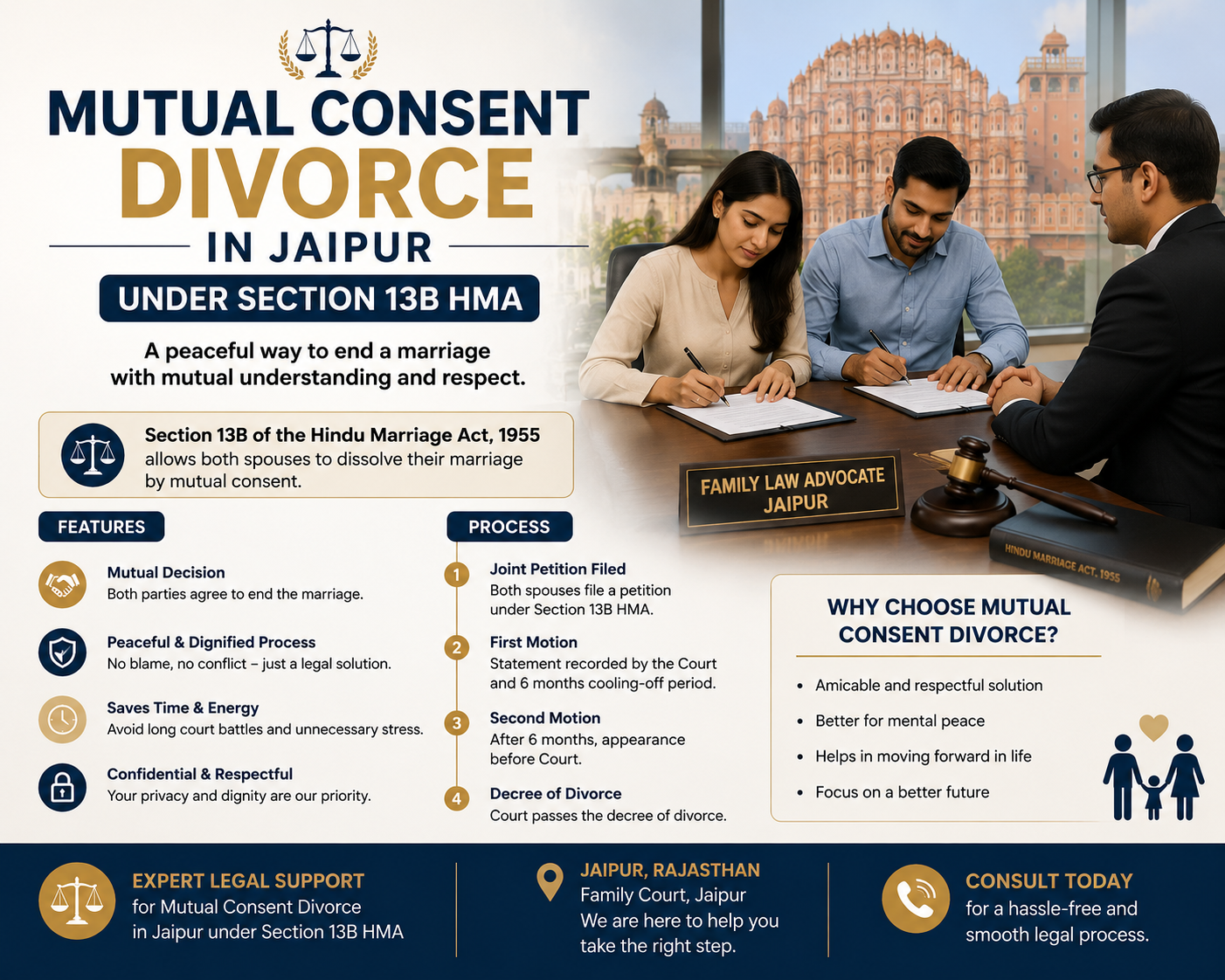
This subsection provides for the “cooling-off period.” After filing the first motion petition, parties must wait for six months before filing the second motion. However, the second motion must be filed within eighteen months from the date of the first motion.
If the court is satisfied that consent continues and reconciliation is impossible, a decree of divorce is granted.
Jurisdiction of Family Courts in Jaipur
In Jaipur, mutual consent divorce petitions are generally filed before the Family Court having jurisdiction based on:
1. Place where marriage was solemnized;
2. Place where parties last resided together;
3. Place where wife currently resides.
The establishment of Family Courts aims to promote conciliation and speedy settlement of matrimonial disputes.
Essential Conditions for Mutual Consent Divorce
To obtain divorce under Section 13-B, certain conditions must be fulfilled.
1. Valid Marriage
The marriage must be legally valid under Hindu law. Mutual consent divorce applies only to marriages recognized under the Hindu Marriage Act.
2. Living Separately for One Year
The parties must have lived separately for at least one year before filing the petition. “Living separately” does not necessarily mean living in different houses; it means absence of marital relationship and cohabitation.
3. Mutual Agreement
Both spouses must voluntarily agree that the marriage should be dissolved.
4. Free Consent
Consent must not be obtained through coercion, fraud, pressure, or undue influence. Courts carefully verify the voluntariness of consent before granting divorce.
Procedure for Mutual Consent Divorce in Jaipur
The process generally involves the following stages:
Step 1: Consultation and Settlement
Before filing the petition, parties usually discuss and settle important issues such as:
- Permanent alimony
- Child custody
- Visitation rights
- Division of property
- Return of jewellery and articles
A written settlement agreement is often prepared to avoid future disputes.
Step 2: Drafting and Filing of Joint Petition
A joint petition under Section 13-B is drafted and filed before the Family Court. The petition contains:
- Details of marriage
- Period of separation
- Reasons for incompatibility
- Terms of settlement
The petition must be signed by both parties and supported by affidavits.
Step 3: First Motion
After filing, the court records statements of both spouses individually. The judge verifies:
- Identity of parties
- Voluntary nature of consent
- Authenticity of settlement
If satisfied, the court accepts the first motion.
Step 4: Cooling-Off Period
Traditionally, parties must wait for six months before filing the second motion. The purpose is to provide an opportunity for reconciliation.
However, courts may waive this period in appropriate cases.
Step 5: Second Motion
After the cooling-off period or its waiver, both parties appear again before the court and confirm their intention to dissolve the marriage.
If consent continues, the court grants a decree of divorce.
Waiver of Cooling-Off Period
Initially, the six-month waiting period was considered mandatory. However, in Amardeep Singh v. Harveen Kaur, the Supreme Court of India held that the cooling-off period is directory and not mandatory. Courts may waive it if:
- Parties have lived separately for a long time;
- Reconciliation is impossible;
- All disputes are settled;
- Waiting would only prolong suffering.
This judgment significantly accelerated mutual consent divorce proceedings in many Family Courts, including Jaipur.
Important Documents Required
The following documents are generally required:
- Marriage certificate
- Wedding photographs
- Address proof of both parties
- Identity proof
- Passport-size photographs
- Income documents
- Settlement agreement
- Proof of separation
Where children are involved, custody-related documents may also be required.
Important Judicial Decisions
1. Sureshta Devi v. Om Prakash
In Sureshta Devi v. Om Prakash, the Supreme Court held that mutual consent must continue till the final decree. Either party may withdraw consent before the decree is passed.
2. Amardeep Singh v. Harveen Kaur
This landmark case relaxed the mandatory nature of the six-month waiting period and allowed courts to waive it in deserving cases.
3. Anil Kumar Jain v. Maya Jain
In Anil Kumar Jain v. Maya Jain, the Court emphasized that continuous mutual consent is necessary until the decree is granted.
Maintenance and Alimony in Mutual Divorce
One of the most important aspects of mutual consent divorce is settlement regarding maintenance and alimony.
The parties may mutually decide:
- Lump-sum alimony;
- Monthly maintenance;
- Waiver of maintenance rights.
Courts ensure that the settlement is fair and voluntary, especially where the wife is financially dependent.
Child Custody in Mutual Consent Divorce
Where children are involved, courts prioritize the welfare of the child.
The parties may agree regarding:
- Permanent custody;
- Joint custody;
- Visitation rights;
- Educational expenses.
The Family Court examines whether the arrangement protects the best interests of the child.
Advantages of Mutual Consent Divorce
1. Faster Procedure
Mutual consent divorce is generally quicker than contested divorce.
2. Less Mental Harassment
It avoids unnecessary allegations and lengthy courtroom battles.
3. Privacy and Dignity
The process is comparatively peaceful and confidential.
4. Cost-Effective
Since prolonged litigation is avoided, legal expenses are reduced.
5. Better Future Relations
The process helps maintain respectful relations, particularly where children are involved.
Challenges in Mutual Consent Divorce
Despite its advantages, certain challenges remain.
1. Withdrawal of Consent
Either spouse may withdraw consent before the final decree, leading to failure of proceedings.
2. Financial Disputes
Disagreements regarding alimony and property often delay settlement.
3. Emotional Pressure
In some cases, one spouse may face family or societal pressure.
4. Delay in Courts
Although faster than contested divorce, procedural delays may still occur.
Mutual Divorce and Criminal Proceedings
Many matrimonial disputes involve criminal complaints under:
- Indian Penal Code
- Dowry laws
- Domestic violence laws
In several cases, parties settle all disputes during mutual divorce proceedings.
Recently, courts have recognized that settlement through mutual consent divorce may help resolve pending criminal litigation as well.
Social Perspective in Jaipur and Rajasthan
In cities like Jaipur, awareness regarding legal rights and matrimonial remedies has increased significantly. Couples increasingly prefer mutual consent divorce over contested litigation due to:
- Urbanization
- Economic independence
- Professional lifestyles
- Reduced social stigma
At the same time, courts continue to encourage reconciliation wherever possible before granting divorce.
Conclusion
Mutual consent divorce under Hindu Marriage Act, 1955 represents a progressive and humane approach to matrimonial disputes. Instead of compelling unwilling spouses to continue a broken relationship, the law allows them to separate peacefully with dignity and mutual respect.
In Jaipur, Family Courts play an important role in facilitating amicable settlements while ensuring fairness and voluntariness. Judicial decisions such as Amardeep Singh v. Harveen Kaur have further simplified the process by allowing waiver of the cooling-off period in deserving cases.
Mutual consent divorce reduces emotional trauma, saves time and expenses, and helps parties move forward in life without prolonged hostility. However, courts must continue ensuring that consent is genuine and settlements are fair, especially in matters involving women and children.
Thus, Section 13-B of the Hindu Marriage Act reflects the evolving nature of Indian matrimonial law by balancing the sanctity of marriage with the realities of modern relationships and individual freedom.