May 27, 2026
Maintenance and Alimony under Section 125 CrPC and Section 144 BNSS
Introduction
The institution of family is regarded as the foundation of society. The law imposes certain obligations upon family members to maintain those who are dependent upon them. Among these obligations, the duty to provide maintenance is one of the most important. Maintenance ensures that a wife, child, or parent who is unable to support themselves does not suffer from poverty, neglect, or destitution.
In India, maintenance is recognized not merely as a legal right but also as a social and moral obligation. The purpose of maintenance laws is to secure social justice and protect vulnerable sections of society. The constitutional principles contained in Articles 14, 15(3), 21, and 39 of the Constitution of India support the idea that every individual should be able to live with dignity.
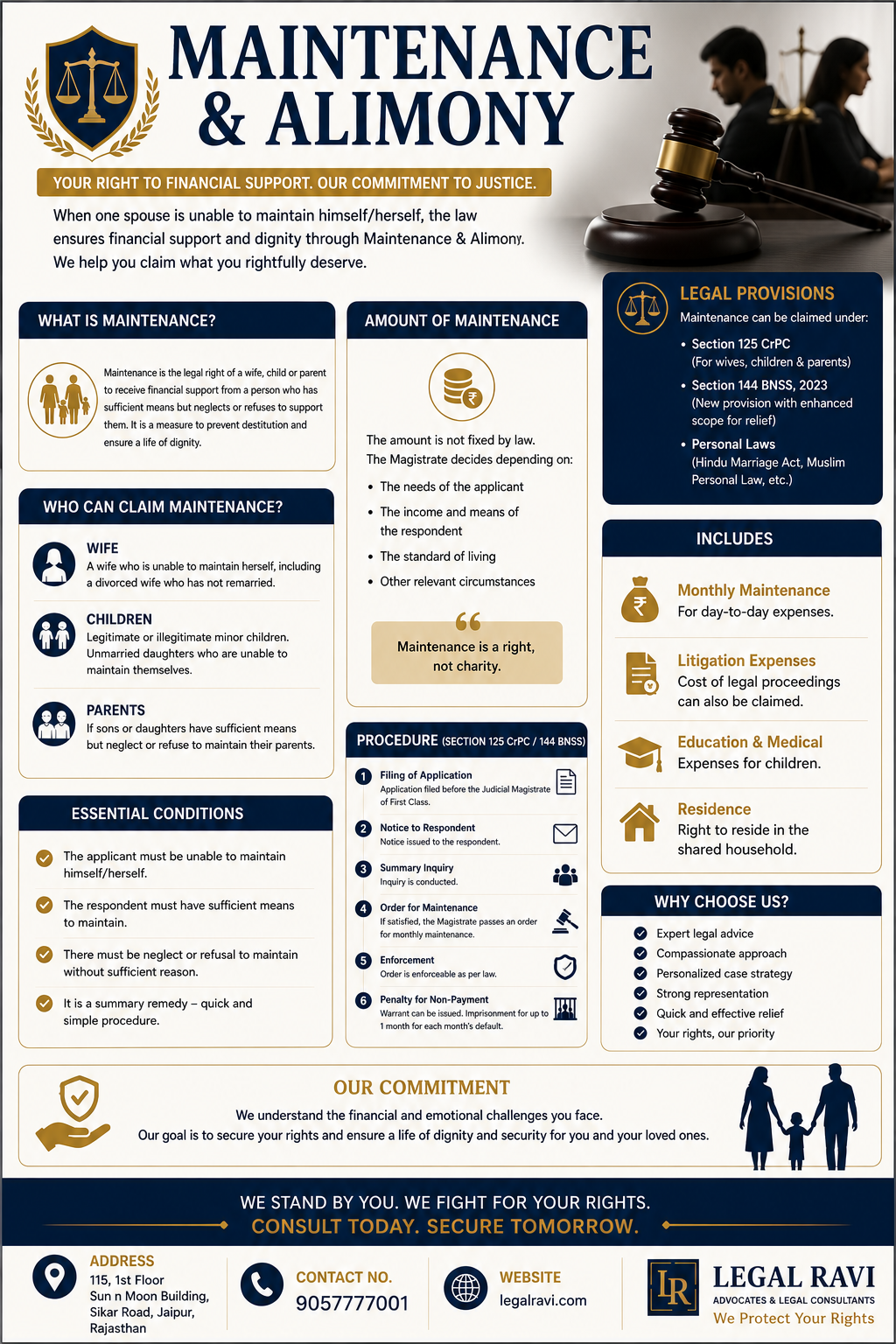
Historically, maintenance proceedings were governed by Section 125 of the Code of Criminal Procedure, 1973 (CrPC). With the introduction of the Bharatiya Nagarik Suraksha Sanhita, 2023 (BNSS), this provision has been incorporated under Section 144 BNSS. Although the numbering has changed, the substance and objective of the law remain substantially the same.
Section 144 BNSS continues to provide a quick, effective, and inexpensive remedy to wives, children, and parents who have been neglected by persons legally bound to maintain them. The provision is secular in nature and applies irrespective of religion, caste, or personal law.
Meaning of Maintenance
The term "maintenance" refers to financial support provided by a person for the sustenance and well-being of another person who is legally entitled to receive such support.
Maintenance includes expenses relating to:
- Food and nutrition
- Clothing
- Shelter and accommodation
- Medical treatment
- Education
- Daily necessities
- Reasonable recreational and social expenses
The concept of maintenance is not limited to mere survival. Courts have repeatedly held that maintenance should enable a person to live with dignity and in a manner consistent with the status enjoyed during the relationship.
In Bhuwan Mohan Singh v. Meena (2015), the Supreme Court observed that maintenance should not be viewed as charity but as a measure to ensure social justice and dignity for women.
Meaning of Alimony
Alimony refers to the financial support granted by one spouse to another after separation, judicial separation, or divorce.
Alimony may be:
1. Temporary (Pendente Lite)
Temporary maintenance granted during the pendency of matrimonial proceedings.
2. Permanent Alimony
A lump-sum amount or periodic payment granted after dissolution of marriage.
The purpose of alimony is to provide financial security to the economically weaker spouse after the breakdown of marriage.
Unlike maintenance under Section 144 BNSS, permanent alimony is generally awarded under matrimonial laws such as:
- Hindu Marriage Act, 1955
- Indian Divorce Act, 1869
- Special Marriage Act, 1954
- Parsi Marriage and Divorce Act, 1936
Historical Development of Maintenance Law
The concept of maintenance existed even in ancient Hindu law where family members were obligated to support dependents.
During the British period, provisions relating to maintenance were incorporated in the Criminal Procedure Code of 1898.
Later, Section 125 CrPC, 1973 became the principal statutory provision dealing with maintenance.
The provision was designed to:
1. Prevent starvation and destitution.
2. Protect women and children.
3. Reduce social injustice.
4. Promote family responsibility.
With the enactment of BNSS in 2023, Section 125 CrPC was replaced by Section 144 BNSS while retaining its essential features.
Nature of Proceedings under Section 144 BNSS
Maintenance proceedings under Section 144 BNSS are:
Civil in Purpose
The objective is recovery of financial support rather than punishment.
Criminal in Procedure
The remedy is provided through criminal courts for speedy and effective relief.
Thus, Section 144 BNSS represents a unique blend of civil rights and criminal procedure.
The Supreme Court has consistently stated that the provision is a measure of social justice and must receive liberal interpretation.
Object of Section 144 BNSS
The primary objectives are:
Prevention of Vagrancy
The law seeks to prevent wives, children, and parents from becoming homeless or dependent on charity.
Social Justice
The provision seeks to protect weaker sections of society.
Family Responsibility
The law enforces the obligation of family members to support their dependents.
Speedy Relief
Unlike lengthy civil suits, maintenance proceedings provide quicker remedies.
The Supreme Court in Captain Ramesh Chander Kaushal v. Veena Kaushal (1978) described Section 125 CrPC as a measure of social justice enacted to protect women and children.
Persons Entitled to Maintenance
1. Wife
A wife who is unable to maintain herself can seek maintenance from her husband.
The term "wife" includes:
Legally Married Wife
A woman whose marriage is legally valid.
Divorced Wife
A divorced woman can claim maintenance if she has not remarried.
Judicially Separated Wife
A wife living separately under a decree of judicial separation.
Muslim Wife
Muslim women are also entitled to maintenance under Section 144 BNSS.
Rights of Second Wife
Generally, a second wife whose marriage is void is not entitled to maintenance.
However, courts have sometimes granted relief where the woman was unaware of the husband's previous marriage.
2. Children
Maintenance may be claimed by:
Legitimate Children
Children born from a valid marriage.
Illegitimate Children
Children born outside marriage.
Minor Children
Both sons and daughters below the age of majority.
Disabled Major Children
Children suffering from physical or mental disabilities who cannot maintain themselves.
The obligation continues irrespective of the child's religion.
3. Parents
Both father and mother are entitled to maintenance.
Important features:
- Married daughters may also be directed to maintain parents.
- Adoptive parents can claim maintenance.
- Elderly parents are protected against neglect.
This provision complements the provisions of the Maintenance and Welfare of Parents and Senior Citizens Act, 2007.
Essential Ingredients of Section 144 BNSS
For obtaining maintenance, the following elements must be proved:
1. Existence of Relationship
The claimant must establish the legal relationship.
Examples:
- Wife-husband
- Parent-child
- Child-parent
2. Neglect or Refusal
The respondent must have neglected or refused to provide maintenance.
Neglect may be:
- Express refusal
- Abandonment
- Failure to provide financial support
3. Sufficient Means
The respondent must possess sufficient means.
The term "means" includes:
- Salary
- Business income
- Professional income
- Rental income
- Agricultural income
- Investments
- Earning capacity
A person cannot avoid liability by remaining voluntarily unemployed.
4. Inability to Maintain Oneself
The claimant must prove inability to maintain themselves.
The Supreme Court has clarified that a wife need not be completely destitute before seeking maintenance.
Interim Maintenance
Interim maintenance refers to temporary financial assistance granted during the pendency of proceedings.
Purpose
- Immediate financial relief.
- Meeting daily expenses.
- Litigation costs.
- Protection against hardship.
The Supreme Court in Rajnesh v. Neha (2020) emphasized that applications for interim maintenance should be decided expeditiously.
Determination of Maintenance Amount
There is no fixed formula for calculating maintenance.
Courts consider:
Financial Position of Husband
Income, assets, investments, and earning capacity.
Needs of Wife
Food, housing, education, medical expenses, transportation, and lifestyle.
Status of Parties
Social and economic status during marriage.
Dependents
Number of children and family responsibilities.
Inflation
Rising cost of living.
Liabilities
Loans, taxes, and other obligations.
The guiding principle is that the wife should be able to maintain a standard of living similar to that enjoyed during marriage.
Grounds for Refusal of Maintenance
Maintenance may be denied if:
Living in Adultery
A wife continuously living in an adulterous relationship may lose her right.
Refusal to Live with Husband Without Cause
Maintenance may be denied if separation is without reasonable justification.
Mutual Consent Separation
If parties voluntarily agree to live separately.
However, cruelty, domestic violence, dowry demands, second marriage, and harassment constitute valid grounds for living separately.
Enforcement of Maintenance Orders
If maintenance is not paid:
Recovery Warrant
The court may issue a warrant for recovery.
Attachment of Property
Assets may be attached.
Imprisonment
The defaulter may be sentenced to imprisonment according to law.
The purpose is to ensure compliance and prevent misuse of the judicial process.
Landmark Judicial Decisions
Read Advocate Ravi Rai Sharma's detailed analysis on the landmark ruling: Supreme Court Rules Adultery Evidence Can Bar Interim Maintenance u/s 125 CrPC / 144 BNSS
Shah Bano Case (1985)
Mohd. Ahmed Khan v. Shah Bano Begum
The Supreme Court held that a divorced Muslim woman is entitled to maintenance if unable to maintain herself.
This case became a milestone in maintenance jurisprudence.
Danial Latifi v. Union of India (2001)
The Court interpreted Muslim women's rights broadly and ensured reasonable and fair provision after divorce.
Chaturbhuj v. Sita Bai (2008)
The Court held that the object of maintenance law is to prevent destitution.
A wife need not be absolutely helpless to claim maintenance.
Shamima Farooqui v. Shahid Khan (2015)
The Court held that a husband cannot escape liability by pleading financial difficulties.
Maintenance must be realistic and sufficient.
Rajnesh v. Neha (2020)
This landmark judgment introduced:
- Mandatory disclosure of assets.
- Uniform guidelines.
- Rules regarding overlapping maintenance claims.
- Standardized procedures.
It is currently the leading authority on maintenance law in India.
Maintenance under Different Personal Laws
Hindu Law
- Section 24, Hindu Marriage Act (interim maintenance)
- Section 25, Hindu Marriage Act (permanent alimony)
- Hindu Adoptions and Maintenance Act, 1956
Muslim Law
- Muslim Women (Protection of Rights on Divorce) Act, 1986
- Section 144 BNSS
Christian Law
- Indian Divorce Act, 1869
Parsi Law
- Parsi Marriage and Divorce Act, 1936
The remedy under Section 144 BNSS is independent of personal laws and can be invoked separately.
Changes under BNSS, 2023
Section 144 BNSS substantially replaces Section 125 CrPC.
Key features retained:
- Protection of wives, children, and parents.
- Summary proceedings.
- Interim maintenance.
- Enforcement mechanisms.
- Social welfare objective.
Therefore, the legislative change is largely structural rather than substantive.
Conclusion
Maintenance law represents one of the most significant welfare measures in Indian legal jurisprudence. Section 125 CrPC, now Section 144 BNSS, reflects the constitutional commitment to social justice, human dignity, and gender equality. The provision ensures that wives, children, and parents are not left vulnerable due to neglect by those legally obligated to support them.
The judiciary has consistently interpreted maintenance provisions liberally to advance their welfare objective. Landmark decisions such as Shah Bano, Danial Latifi, Chaturbhuj, Shamima Farooqui, and Rajnesh v. Neha have expanded and strengthened the rights of dependents.
In modern India, maintenance is no longer viewed as an act of charity but as an enforceable legal right. Section 144 BNSS continues to serve as a powerful tool for protecting vulnerable family members and ensuring that every individual can live with dignity, security, and self-respect.