August 09, 2026
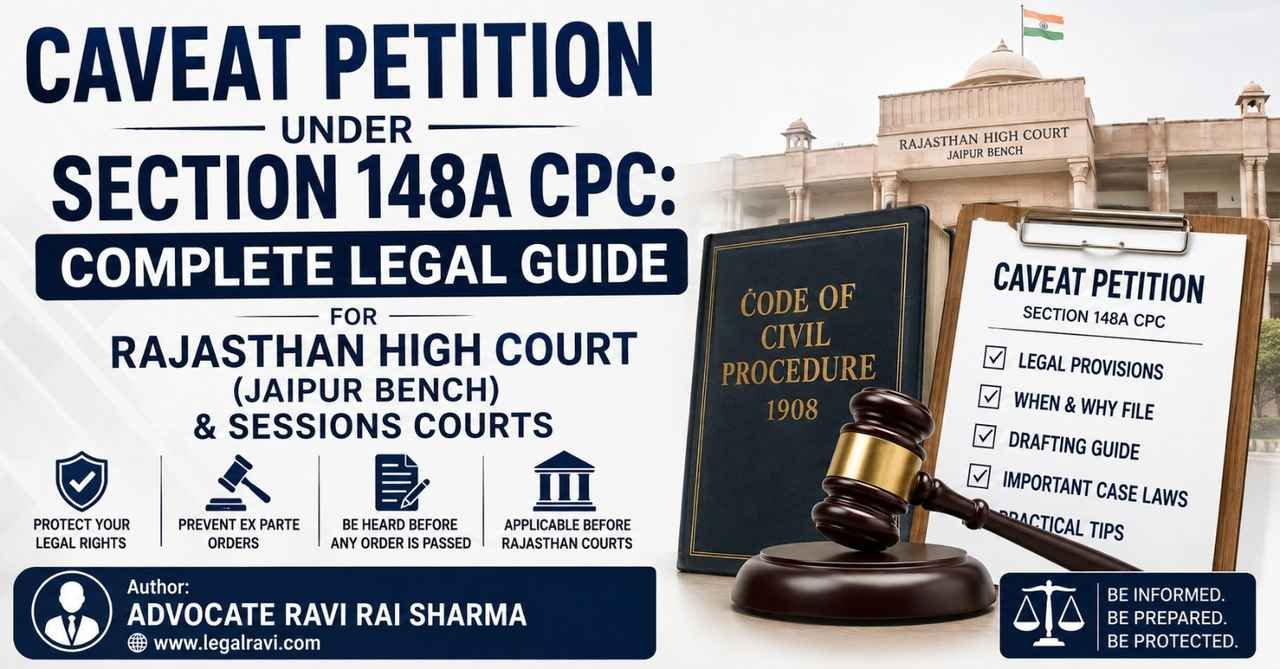
CAVEAT PETITION : COMPLETE LEGAL GUIDE FOR RAJASTHAN HIGH COURT & SESSIONS COURTS
1. WHAT IS A CAVEAT PETITION UNDER SECTION 148A CPC?
The term “Caveat” originates from the Latin expression meaning “let a person beware.” In Indian civil jurisprudence, a Caveat Petition under Section 148A of the Code of Civil Procedure (CPC), 1908 (introduced via the CPC Amendment Act, 1976) is a preventive legal remedy lodged by a party (the Caveator) who reasonably apprehends that an adverse ex-parte order, stay, or interim injunction may be sought against them by an opposing party in an anticipated or pending civil suit, writ petition, or statutory appeal.
The fundamental constitutional purpose of Section 148A CPC is to uphold the natural justice principle of Audi Alteram Partem (hear the other side). It explicitly prevents the court from issuing unilateral, surprise interim stay orders without affording the Caveator a fair opportunity to present their defense.
2. STATUTORY FRAMEWORK & MANDATORY DUTIES UNDER SEC 148A CPC
Section 148A lays down specific statutory rights and procedural mandates across five subsections:
1. Sub-section (1) – Right to Lodge a Caveat: Any person claiming a right to appear before the court on the hearing of an application expected to be made, or already made, in a suit or proceeding may lodge a caveat.
2. Sub-section (2) – Duty of the Caveator: Upon lodging the caveat, the Caveator must forthwith serve a copy of the caveat petition by Registered Post AD or Speed Post on the anticipated applicant/opponent.
3. Sub-section (3) – Duty of the Court: Once a caveat is registered, the Court shall serve a mandatory notice of any application filed by the opponent to the Caveator or their designated legal counsel before passing any interim relief.
4. Sub-section (4) – Obligation of the Applicant: The applicant, upon receiving notice of a registered caveat, is legally bound to furnish a complete set of the petition, stay application, and supporting documents/affidavits to the Caveator at the Caveator's expense.
5. Sub-section (5) – Statutory Validity Period: A caveat petition remains in active force for 90 days from the date of lodging. If no application is filed within 90 days, a fresh caveat must be lodged to maintain uninterrupted legal protection.
For full statutory reference, check the official Code of Civil Procedure, 1908 on India Code Portal.
3. HIGH COURT OF JUDICATURE FOR RAJASTHAN (JAIPUR BENCH): SPECIAL CAVEAT RULES
Filing a caveat before the Rajasthan High Court (Jaipur Bench) involves adherence to the Rajasthan High Court Rules, 1952 alongside Section 148A CPC:
· Jurisdiction Mapping: High Court caveats are essential in S.B. Civil Writ Petitions (SBCWP), Special Appeals (Writ / SAW), First Appeals (FA), Second Appeals (SA), Civil Revision Petitions, and Arbitration Applications.
· Mandatory Court Fee & Stamp Duty: As prescribed under the Rajasthan Court Fees and Suits Valuation Act, appropriate court fees and Advocate Welfare Fund stamps must be affixed.
· Caveat Register Verification: Upon submission at the Central Filing Counter of the High Court Jaipur Bench, the filing clerk verifies the party details, lower court suit number, and subject matter before generating an official Caveat Registration Number.
· e-Filing Integration: Rajasthan High Court mandates structured e-filing via the official CIS portal. Caveat petitions must contain accurate Mobile Numbers and Email Addresses of both the Caveator and the Advocate to trigger automated SMS/Email alerts whenever a matching petition is uploaded by the opponent.
To track e-filing status or court listings, visit the official Rajasthan High Court Portal.
4. CAVEAT PRACTICE IN DISTRICT & SESSIONS COURTS, JAIPUR
Apart from the High Court, caveats are extensively utilized across lower forums in Jaipur, including the District Court Campus (Bani Park), Commercial Courts (Mini Secretariat), and Revenue Courts (Board of Revenue / Divisional Commissioner Office):
1. Property & Real Estate Disputes (Civil Suits u/O 39 Rules 1 & 2 CPC): Landowners, builders, and buyers file caveats to prevent ex-parte temporary injunctions regarding property possession or construction halts.
2. Commercial & Contractual Arbitrations: Preventing ex-parte asset attachment or bank guarantee encashment orders under Section 9 of the Arbitration and Conciliation Act.
3. Service & Employment Litigation: Employees or Management filing caveats against stay orders on termination, transfer, or promotion rosters.
4. Matrimonial & Succession Matters: Preventing ex-parte orders in probate proceedings, succession certificates, or guardianship applications.
Explore cause lists and lower court listings via the eCourts India Services Portal.
5. COMPARATIVE ANALYSIS: CAVEAT PETITION VS. LEGAL NOTICE
Feature
Caveat Petition (Sec 148A CPC)
Formal Legal Notice
Primary Objective
Prevents Court from passing ex-parte stay orders.
Demands compliance or warns of upcoming legal action.
Forum
Filed directly in the Court Registry.
Served privately on the opposite party.
Binding Force on Court
Mandatory duty on Court to notify Caveator before interim order.
No direct judicial obligation on court proceedings.
Validity
Strictly 90 Days (Renewable).
Indefinite, subject to Limitation Act provisions.
Applicability Scope
Civil Matters Only (Not applicable to core Criminal Trials).
Applicable across Civil, Commercial, and Criminal contexts.
6. STEP-BY-STEP PROCEDURE TO FILE A CAVEAT PETITION IN JAIPUR
7. REAL-WORLD LEGAL EFFECTS OF FILING A CAVEAT PETITION U/S 148A CPC
A Caveat Petition is not merely a formality; it alters the procedural dynamics of civil litigation in the following concrete ways:
· Effect 1: Complete Nullification of Ex-Parte Relief
Once a caveat is registered in the court's CIS database, the judge cannot issue a temporary injunction, status quo order, or stay order without first providing written notice and hearing the Caveator.
· Effect 2: Legal Consequence of Court Error (Passing Stay Despite Caveat)
If a court inadvertently passes an ex-parte stay order without notifying the registered Caveator, such an order suffers from procedural irregularity. The Caveator has the absolute right to move an urgent application for immediate vacation/recall of the stay order based on the violation of Section 148A(3) CPC.
· Effect 3: Mandatory Supply of Opponent’s Documents
Under Section 148A(4), the applicant/opponent is legally obligated to immediately deliver a full copy of the writ petition, civil suit, stay application, and supporting affidavits to Advocate Ravi Rai Sharma at the applicant’s expense.
· Effect 4: Shift of Strategic Advantage in High Court
Instead of fighting to overturn an already granted stay order, the Caveator enters the High Court on equal footing on Day 1, presenting counter-arguments before any interim restriction is imposed on their property, business, or service status.
8. LANDMARK JUDICIAL PRECEDENTS ON SECTION 148A CPC
· C.G. Govindan v. E.K. Guptan (AIR 1986 Ker 205): The High Court held that passing an ex-parte order without notifying a registered caveator violates the mandatory provisions of Section 148A(3), rendering such interim orders legally vulnerable to discharge upon appeal. Read case law analysis on Indian Kanoon.
· K. Rajasekaran v. K. Sakunthala (2008): The Supreme Court emphasized that mandatory service of caveat notice on the adversary under Section 148A(2) is a condition precedent. Failure of the caveator to serve the opponent deprives them of asserting procedural non-compliance against the court. Reference available on Supreme Court of India Official Judgments.
· Reserve Bank of India v. Ashis Chakraborty (1987): Reaffirmed that a caveat does not create a substantive right or block suit institution; it acts purely as a procedural shield to guarantee audi alteram partem before granting interim ex-parte injunctions. Detailed ruling on eSCR Supreme Court Reports.
9. FREQUENTLY ASKED QUESTIONS & CRITICAL LEGAL SCENARIOS (FAQS)
Q1: What is the effect of a Caveat Petition if the opponent does not file any case within 90 days?
Effect: The caveat automatically lapses after 90 days under Section 148A(5) CPC. If you still apprehend litigation, a fresh Caveat Petition must be re-filed immediately with updated postal receipts to maintain continuous legal protection in the High Court or Sessions Court.
Q2: Does a Caveat Petition apply to Criminal Cases or FIR Quashing u/s 528 BNSS?
Effect: Section 148A CPC strictly governs civil proceedings, writ petitions, and statutory appeals. However, in criminal matters involving anticipatory bail or FIR quashing, informal representations or caveats in specific statutory forums can be utilized to inform the Court or Prosecution. Read our detailed analysis on Section 528 BNSS FIR Quashing & Criminal Defense Strategy.
Q3: What is the financial and time effect of filing a Caveat in Jaipur High Court?
Effect: Filing a caveat saves substantial time and money by preventing prolonged stay-vacation proceedings. A single ex-parte stay on real estate construction or bank accounts can halt operations for months, whereas a proactive caveat resolves the interim dispute during the initial admission stage itself.
10. WHY CHOOSE ADVOCATE RAVI RAI SHARMA FOR CAVEAT FILING IN JAIPUR?
Navigating High Court litigation requires swift legal action, accurate registry tracking, and flawless drafting to prevent jurisdictional invalidation:
· Strategic High Court & Sessions Practice: Advocate Ravi Rai Sharma and his team at RS & Associates Law Firm specialize in urgent High Court Caveat petitions, Civil Writs, and District Court stay defenses across Jaipur, Rajasthan.
· Real-Time CIS Tracking: Advanced digital monitoring of High Court filing dockets ensures that as soon as an opponent uploads a petition, immediate notice is received, allowing our defense strategy to be deployed prior to bench listing.
End-to-End Legal Counsel: From drafting comprehensive caveats to presenting strong oral arguments against interim stay applications before High Court Judges and District Bench Judges.
📞 NEED IMMEDIATE CAVEAT FILING OR HIGH COURT LEGAL REPRESENTATION IN JAIPUR?
· Chamber Office: RS & Associates Law Firm, 117-A, 1st Floor, Sun N Moon Building, VKIA-1, Near Manipal Hospital, Sikar Road, Jaipur, Rajasthan 302039
· Direct Consultation & Booking: Schedule High Court Legal Consultation with Advocate Ravi Rai Sharma
· Official Website Portal: RS & Associates Law Firm - Advocate Ravi Rai Sharma