July 10, 2026
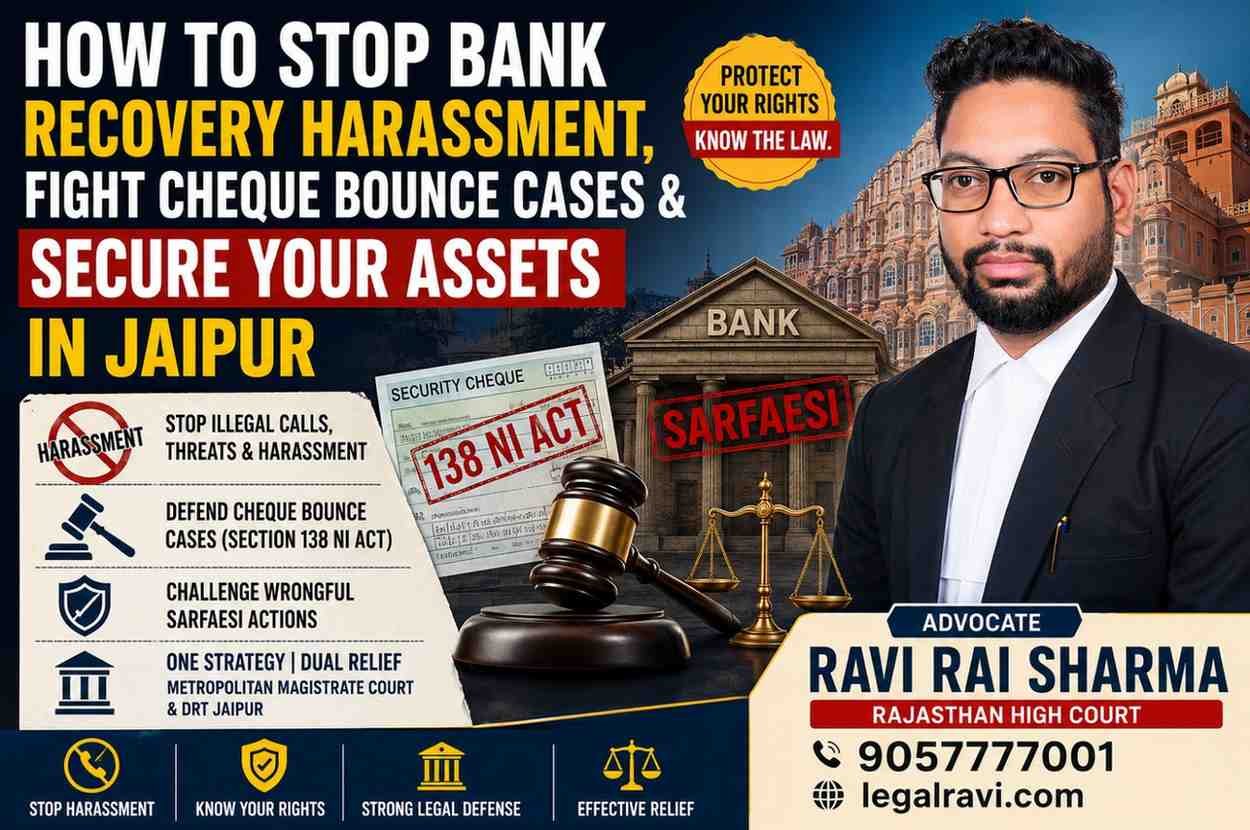
How to Stop Bank Recovery Harassment, Fight Cheque Bounce Cases in Jaipur
By Advocate Ravi Rai Sharma (LegalRavi)
Primary Practice Areas: Debts Recovery Tribunal (DRT) Rajasthan, High Court of Rajasthan (Jaipur Bench), and Strategic Financial Litigations.
Office Chambers: Sikar Road, Jaipur, Rajasthan.
Running a business enterprise or managing corporate financial responsibilities in Rajasthan’s capital JAIPUR is an exercise in managing volatile market dynamics. Whether you operate a handicraft manufacturing plant in the busy industrial lanes of the Sitapura Industrial Area, a traditional gemstone cutting business within the historical gates of Johari Bazar, a retail setup in Raja Park, or a modern corporate agency inside C-Scheme, financial cycles are rarely uniform. There are periods of high liquidity, and there are phases where operational cash flows dry up completely due to delayed market realizations, unexpected economic shifts, or sudden personal emergencies.
When a substantial commercial cash crunch hits, the immediate casualty is your debt servicing capability. You miss a couple of Equated Monthly Installments (EMIs) on your business credit line, or you fall behind on your unsecured personal loan or credit card minimum due amounts. Up to this point, the dispute is entirely commercial—a basic civil breach of a financial contract between a borrower and a lender.
However, instead of initiating professional financial restructuring, major private banking corporations, aggressive non-banking financial companies (NBFCs), and digital lending desks often deploy a brutal, coordinated legal and psychological strategy designed to collapse your mental peace.
Suddenly, you find yourself facing an onslaught of continuous automated phone calls, vulgar threats from third-party bouncers claiming to be a registered credit card recovery agency, and parallel criminal summonses arriving from the Metropolitan Magistrate Courts in Bani Park, Jaipur. Lenders frequently misuse the blank signed security cheques collected during loan disbursement to file aggressive criminal cases under Section 138 of the Negotiable Instruments (NI) Act, while simultaneously moving to auction your ancestral family home or commercial buildings under the SARFAESI Act, 2002.
If you are trapped in this stressful position, you must realize something instantly: Financial distress is a hard phase of business, but it is not a crime. The constitution and the regulatory frameworks of India guarantee you absolute civil protection. This comprehensive statutory guide is engineered to arm you with the precise on-the-ground strategies required to silence predatory collection agencies, defeat false cheque bounce prosecutions, challenge aggressive bank asset auctions, and secure a dignified resolution through structured debt settlement.
1. A Civil Default is Not a Criminal Offense
The primary strategy employed by collection cells when managing an unsecured debt default is the systemic creation of blind panic. They rely on the fact that an average retail consumer or small business owner is not fully aware of their statutory legal rights. Telecallers and field bouncers will deliberately drop intimidating phrases like "immediate police arrest," "non-bailable warrants," "police raid at your house," or "attachment of personal belongings."
Let let us lay down the raw legal position as it stands under Indian jurisprudence:
A. The Separation of Police Power from Debt Recovery
The police force of Rajasthan is established to maintain public order, investigate statutory crimes, and ensure safety. The police have absolutely zero statutory jurisdiction to intervene in a civil default involving a bank loan, a credit card bill, or a personal line of credit. A police officer from the Mansarovar Police Station or the Shyam Nagar Police Station cannot simply march into your private residence and place you under arrest because your loan account has transitioned into a Non-Performing Asset (NPA). Any attempt by a bank to use local police influence to force a payment without an explicit judicial order is a obvious violation of due process.
B. The Myth of Fake Legal Notices via WhatsApp
In recent years, recovery departments have started distributing PDF documents labeled as "High Court Summons," "Police Arrest Intimation," or "Immediate Seizure Orders" over informal WhatsApp chats. If you receive a document threatening jail time sent from an unverified, random mobile number, it is almost certainly a fabricated piece of paper meant to cause distress. A legitimate judicial notice from a competent civil or criminal court in Jaipur is always served via an official court bailiff or via registered post, containing a valid, verifiable case number registered on the official E-Courts portal.
C. The Right to Absolute Physical Protection of Property
No field agent or representative of a loan settlement agency has the legal right to cross the threshold of your home or office without your explicit invitation. They cannot forcefully enter your premises, change your door locks, or attempt to walk away with your personal belongings such as electronics, vehicles, or stock inventory. Any unauthorized entry into your space after you have clearly instructed the individuals to leave constitutes the distinct criminal offense of Criminal Trespass. Forcible removal of property without a valid, written execution decree from a competent civil judge or district magistrate amounts to plain extortion and theft.
2. RBI Rules for Recovery Agents
The Reserve Bank of India (RBI) has repeatedly issued strict warnings against the high-handed, aggressive, and abusive operational tactics used by banks and financial entities during debt recovery. Under the comprehensive Master Directions on Fair Practices Code, the central bank has established clear boundary lines. If a lender or an outsourced collection agency crosses these lines, they face massive institutional fines and potential regulatory suspension.
If you are trying to understand recovery agent harassment se kaise bache? you must evaluate the collection calls and visits you receive against these explicit, mandatory RBI guidelines:
"According to the strict fair practices framework laid down under the Reserve Bank of India Guidelines, Guidelines for the recovery agents, lenders and their recovery departments are bound by legal time windows and ethical codes of conduct that restrict unnecessary interference with a borrower's privacy."
The Legal Operational Framework for Collectors
· The Permissible Calling and Visiting Window (8:00 AM to 7:00 PM): Recovery executives and telecallers are legally prohibited from turning your life into a 24-hour psychological nightmare. They are strictly barred from initiating phone calls or making physical visits before 8:00 AM in the morning or after 7:00 PM in the evening. Calls placed at 9:30 PM, 11:00 PM, or surprise knocks at dawn are explicit, actionable violations of the law.
· The Absolute Prohibition on Third-Party Shaming: A financial liability is a strictly confidential contractual matter between the borrower and the financial institution. Lenders are legally bound by privacy codes. An agent cannot call your distant relatives, send messages to your friends on social media networks, or visit your corporate office in Malviya Nagar or Jagatpura to discuss your financial distress with your employer or colleagues. Standing outside your house in a residential colony in Vaishali Nagar and shouting or creating a scene to ensure your neighbors gather to watch the humiliation is a massive violation of your fundamental Right to Privacy under Article 21 of the Constitution.
· Mandatory Physical Credentials: Any field agent visiting your commercial space or home must carry two specific items: An official, clear photo identity card issued by the financing bank or the registered collection agency, and a copy of the bank's formal Authorisation Letter explicitly linking their agency to your unique loan file. If an individual shows up at your door without these credentials, you have the full statutory right to deny them interaction and ask them to exit your property immediately.
· The Ban on Masked or Anonymous Numbers: Telecallers cannot use hidden, private, or international routing numbers to issue threats. Lenders must ensure that all official recovery calls originate from registered corporate lines that can be tracked, recorded, and audited during a regulatory inspection.
3. Filing a Bank Recovery Agent Harassment Complaint
When a credit card recovery agency or a bank collection desk crosses the line from professional communication into verbal abuse, continuous digital bullying, or physical threats, they exit the protection of civil law and enter the territory of criminal accountability. You must stop arguing with callers and start building a structured legal file to put the lender on the defensive.
Step-by-Step Action Plan to Fight Back:
Step 1: The Collection of Concrete Evidence
The legal framework runs entirely on hard evidence, not emotional distress statements.
· Install an automatic call recording application on your mobile device to capture every verbal exchange, threat, or instance of foul language.
· Save every threatening SMS text message and take clear, timestamped screenshots of abusive WhatsApp conversations, making sure the sender's full phone number is visible.
· If field bouncers show up at your shop or home, use your smartphone to record a clear video of their conduct, or ensure your local CCTV security footage is safely backed up.
Step 2: Filing a Formal Police FIR Under Modern Criminal Laws
When an agent threatens your physical safety, blocks your exit, or uses vulgar words against your family members, they are committing clear offenses under the Bharatiya Nyaya Sanhita (BNS). You must take your recorded video and audio proof to your local Jaipur police station (such as the Sikar Road Police Station or the Bani Park Police Station) and file a formal written complaint requesting the registration of an FIR under the following provisions:
· Section 351 (2) and 352 BNS (Criminal Intimidation): This applies directly when an agent threatens you, your spouse, or your children with injury, social ruin, or physical harm to force a financial payment.
· Section 356 BNS (Criminal Defamation): This is triggered when collectors intentionally attack your social standing by telling your neighbors, colleagues, or friends that you are a financial fraudster or cheat.
· Criminal Trespass and Extortion: Forcibly entering your office premises, sitting down to disrupt your business transactions, or snatching your car keys without a valid judicial seizure order constitutes distinct criminal acts.
Forwarding a certified copy of a registered police FIR to the principal compliance officer or the Principal Nodal Officer of the bank is often enough to ensure that the rogue collection agency is permanently removed from your file.
Step 3: Triggering the RBI Integrated Ombudsman Route
If you file a formal written grievance with the bank’s internal Customer Grievance Redressal desk and they fail to provide a satisfactory resolution or stop the harassment within 30 days, you can bypass the bank entirely.
Lodge a comprehensive case online at the official RBI Integrated Ombudsman Portal. The portal is an independent, free dispute resolution platform provided by the central bank. Attach your recorded phone clips, call logs, and abusive text screenshots. The RBI treats recovery-related misconduct with extreme strictness. If the tracking verification proves harassment, the Ombudsman has the power to levy heavy financial penalties on the bank, wipe off unfair penal charges, and order the bank to pay direct financial compensation to you for the mental agony and loss of reputation.
4. Section 138 Cheque Bounce Criminal Trap
In the business circles of Jaipur—especially within major trade zones like the Vishwakarma Industrial Area (VKI) or commercial centers like C-Scheme—lenders routinely weaponize Section 138 of the Negotiable Instruments (NI) Act. At the time of original loan application or CC limit setup, you are required to submit blank, signed cheques as security. When financial defaults occur, banks often fill in highly inflated amounts, present these cheques knowing they will bounce, and then file a criminal complaint to threaten you with imprisonment.
If you receive a formal criminal summons from the Metropolitan Magistrate Court at the Bani Park Court complex, you must approach the matter with a highly calculated, technical defense strategy:
[Cheque Bounces] ---> [Bank Must Serve 138 Legal Notice Within 30 Days]
|
v
[Borrower Has 15 Days to Respond/Pay]
|
v
[If Unpaid, Bank Must File Criminal Complaint Within Next 30 Days]
Key Legal Defenses in a Section 138 NI Act Matter:
The Defense of "Legally Enforceable Debt"
A cheque bounce conviction cannot stand in a court of law if the amount written on the cheque does not represent a legally valid, enforceable debt on the exact day it was presented for clearance. If the bank has inflated the balance by adding arbitrary penalties, hidden fees, or unconscionable compounding interest rates that violate your core loan agreement, your defense counsel can challenge the validity of the original debt calculation during cross-examination.
Strict Adherence to Statutory Timelines
The NI Act is driven by rigid timelines. The bank must issue a formal legal notice to you within exactly 30 days of receiving the cheque return memo from the clearinghouse. Upon receiving that notice, you have exactly 15 clear days to respond or resolve the matter. The criminal complaint can only be legally filed within the next 30 days after the 15-day window closes. If the bank's automated legal desk misses a single day in this strict statutory timeline, the entire criminal case is technically flawed and can be dismissed.
Handling Section 143A Interim Compensation
Under the updated Negotiable Instruments framework, the magistrate court can direct the accused borrower to deposit up to 20% of the bounced cheque amount as interim compensation during the pendency of the criminal trial. However, this provision is directory and discretionary, not mandatory. A skilled defense advocate can present detailed arguments showing that the underlying debt is already under challenge before the Debts Recovery Tribunal (DRT) Jaipur, or that the bank has flagrantly misused a blank security cheque, thereby staying or minimizing any immediate liability for interim compensation.
5. DRT Jaipur and SARFAESI Defenses
If your defaulted liability involves a secured loan—such as a commercial property mortgage, a factory loan, or a home loan where the total outstanding amount exceeds ₹20 Lakhs—the bank will eventually move beyond third-party collection agencies. They will deploy their formal legal departments to issue statutory notices under the SARFAESI Act, 2002.
When a bank serves a notice under Section 13(2) or Section 13(4) of the SARFAESI Act, intending to take symbolic or physical possession of your property and put it up for public auction, the standard local civil courts lose their jurisdiction under Section 34 of the Act. Your primary, most powerful legal forum becomes the Debts Recovery Tribunal (DRT) Rajasthan, situated right here in Jaipur.
How to Mount a Strategic Defense Before the DRT Jaipur Bench:
Filing a Securitization Application (SA) Under Section 17
You have a strict statutory window of exactly 45 days from the date the bank takes an enforcement action (like serving a Section 13(4) possession notice or publishing an auction proclamation) to file a Securitization Application before the DRT Jaipur Bench. This is your exclusive opportunity to audit the bank's recovery process.
Exposing Critical Technical and Procedural Flaws
Lenders and their authorized officers routinely commit fatal technical errors while rushing to execute property auctions. Under the Security Interest Enforcement Rules, banks must strictly comply with mandatory protocols:
· They must serve a clear 30-day public auction notice to the borrower before the first sale attempt.
· They must physically affix the possession notice on a visible part of the property and publish it in two leading local newspapers within 7 days of the action.
· They must secure a proper, certified valuation report from an approved valuer before setting the reserve price for the auction.
If your banking advocate brings these specific procedural violations to light before the DRT Judge, the tribunal has the complete authority to set aside the bank's entire recovery process, cancel the upcoming public sale, and stop a property auction cold.
6. The "Lawyer Panel" Mirage: Why Independent Representation Matters
As financial litigation has risen across Rajasthan, many borrowers find themselves searching the web for quick, digitized, or centralized debt relief solutions. This has led to heavy search volumes tracking terms like Lawyer Panel fake or real, Lawyer Panel review, or seeking validation via a Lawyer Panel loan settlement review quora.
Many people search for a generic Lawyer Panel toll free number or a Lawyer Panel mobile number hoping for a quick, automated fix to their banking troubles. However, it is vital to understand a basic courtroom reality: A call-center aggregator or an automated online panel cannot sign a physical vakalatnama and stand before a judge to defend your home or shop.
Corporate debt defense and complex financial litigation require a customized, on-the-ground defense strategy. When a Metropolitan Magistrate in Bani Park issues a criminal summons in a 138 case, or when a bank files a petition before the District Magistrate (DM Court Jaipur) seeking physical police arrangement to take over your factory, an automated online service cannot provide the necessary defense. You need an independent, physically accessible, and experienced banking advocate who understands the local judicial procedures of the Rajasthan High Court, the local Jaipur local courts, and the DRT Bench. Independent local counsel audits your specific loan account, identifies local bank compliance errors, and stands personally in court to secure urgent stay orders.
7. The Ultimate Resolution: Strategic One-Time Settlements (OTS)
Lenders dislike lengthy, complex litigation just as much as you do. When a bank encounters an informed borrower who has deployed a strong legal defense—challenging their cheque bounce notice in the magistrate court, filing harassment complaints with the RBI Ombudsman, and securing stay applications before the DRT Jaipur—their institutional leverage vanishes. They realize that recovering the money through force or shortcuts is impossible.
This is the exact point where the dynamic shifts, and you gain the upper hand to negotiate a structured One-Time Settlement (OTS) on your own financial terms:
The Steps to a Successful Debt Settlement:
1. Issuing a Formal Cease-and-Desist Notice: Your legal team issues a precise legal warning to the bank’s regional compliance division. This formalizes the dispute, forces the third-party recovery agencies to disappear instantly, and moves all communication to written, trackable channels.
2. Stripping the Overestimated Balance: We carefully audit your loan ledger account to identify and remove all unacceptable compound interest points, unfair late payment penalties, over-limit charges, and fabricated legal expenses added by the lender.
3. Finalizing the Settlement Agreement: We guide you through the official negotiation table, helping you resolve the entire dispute by paying a realistic fraction of the demanded sum (often close to the actual principal amount) via a clean, structured, and court-sanctioned installment plan that completely clears your name and restores your CIBIL score.
Table Summary: Legal Remediations at a Glance

Conclusion: Reclaiming Your Financial Freedom and Peace of Mind
Financial instability is merely a commercial challenge; it should never be allowed to compromise your personal dignity, your family's safety, or your hard-earned social reputation. Lenders and their outsourced recovery wings rely entirely on fear and misinformation to achieve their targets. The moment you replace that panic with a precise, aggressive, and highly calculated legal strategy, the corporate bullying comes to an end.
Whether you need to issue a severe legal notice to stop aggressive credit card collection agents immediately, file a powerful technical defense against a Section 138 cheque bounce case at the Jaipur local courts, or secure an urgent stay order on an illegal property auction from the Debts Recovery Tribunal (DRT) Rajasthan, you do not have to fight this multi-pronged battle alone.
Protect your business, your family, and your peace of mind by building a professional debt defense network today. Get in touch with the team at LegalRavi to analyze your loan files and execute a clear, strategic path toward absolute financial freedom.
Contact Information for Strategy Consultations:
· Lead Counsel: Advocate Ravi Rai Sharma (LegalRavi)
· Chambers Location: Sikar Road, Jaipur, Rajasthan (Conveniently accessible for clients across Mansarovar, Vaishali Nagar, Malviya Nagar, C-Scheme, Sanganer, and the VKI Area).
· Core Specializations: DRT SARFAESI Litigation, Section 138 Criminal Defense, RBI Ombudsman Redressals, and Corporate Debt Settlements.
· Take Action Today: Click Here to Schedule a Confidential, In-Person Legal Strategy Session at Our Sikar Road Jaipur Office